
Why Is the Sky Blue at Sunset Red? The Science Explained
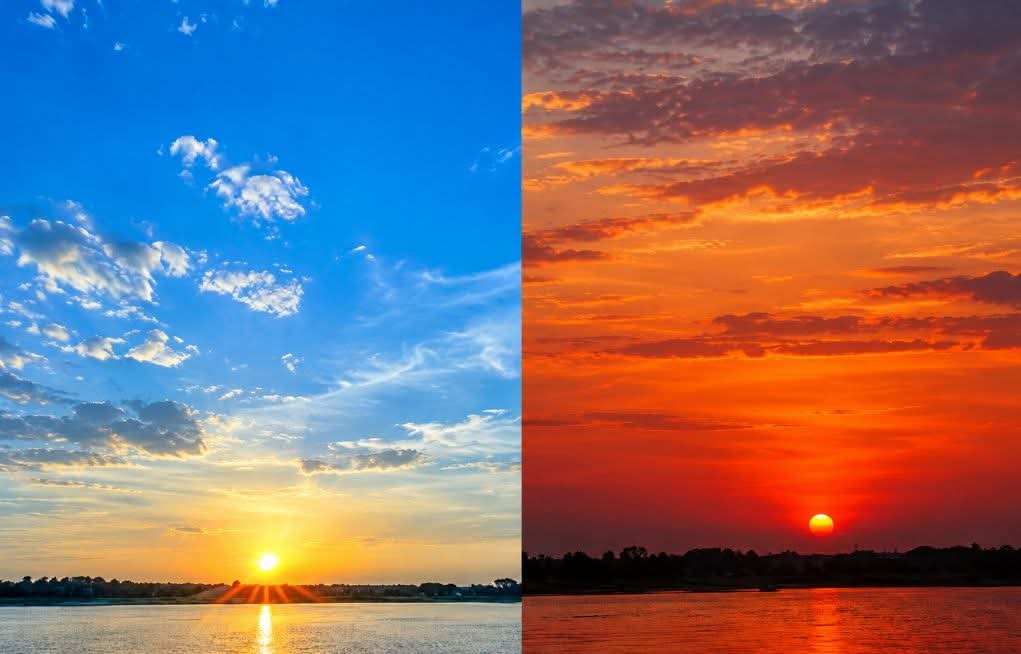
Have you ever looked up at the sky during a morning walk and wondered about its colors? During the day, the sky appears in a bright blue color. However, as the sun sets, that blue disappears. Instead, we see bright red, orange, and crimson tones.
It feels like magic, but science explains this change clearly. In this guide, we will answer why is the sky blue at sunset red. We will also explore Rayleigh scattering and light behavior.
What Is Sunlight Made Of?
To understand sky colors, we must first look at sunlight. Sunlight looks white, but it contains all colors of the visible spectrum.
Light travels in waves with different characteristics:
- Short Wavelengths: Blue, indigo, and violet light have short, high-frequency waves.
- Long Wavelengths: Red, orange, and yellow light have long, low-frequency waves.
When sunlight enters Earth’s atmosphere, it hits gas molecules, dust, and water vapor. These particles scatter the light in different ways.
Why Is the Sky Blue During the Day?
During clear days, the sun stays high in the sky. Sunlight travels a short path to reach us.
As sunlight enters the air, it collides with gas molecules. Short blue waves hit these molecules and scatter easily in all directions. Physicists call this process Rayleigh scattering.
When you look up, scattered blue light enters your eyes from everywhere.
Why Isn’t the Sky Violet?
Violet light has even shorter waves than blue light. However, the sky does not look violet for two reasons:
- The sun emits more blue light than violet light.
- Human eyes are more sensitive to blue light.
Why Is the Sky Blue at Sunset Red?
At sunset, the sun drops low on the horizon. Sunlight must travel a much longer path to reach your eyes. In fact, it passes through ten times more atmosphere than at noon.
Here is what happens during that long journey:
- Blue light scatters away: The short blue wavelengths bounce off air molecules repeatedly. Most blue light scatters away before reaching you.
- Red light passes through: Red, orange, and yellow wavelengths are longer. They pass through the thick air without scattering much.
Because blue light scatters out, mostly red and orange wavelengths reach your eyes.
Do Dust and Clouds Make Sunsets More Vibrant?
Clean air scatters blue light well. However, larger particles like dust, sea salt, and smoke scatter light differently.
When the air contains the right amount of particles, red light scatters more dramatically. High clouds also catch the remaining red rays and reflect them down to Earth.
Key Takeaways
- Sunlight contains all visible colors with different wavelengths.
- Rayleigh scattering spreads short blue light across the sky during midday.
- Sunlight travels farther at sunset, filtering out blue light and leaving red tones.