Are We Living Inside a Black Hole? This JWST Discovery Could Change Everything About Our Understanding of the Universe
Are We Living Inside a Black Hole? This JWST Discovery Could Change Cosmology
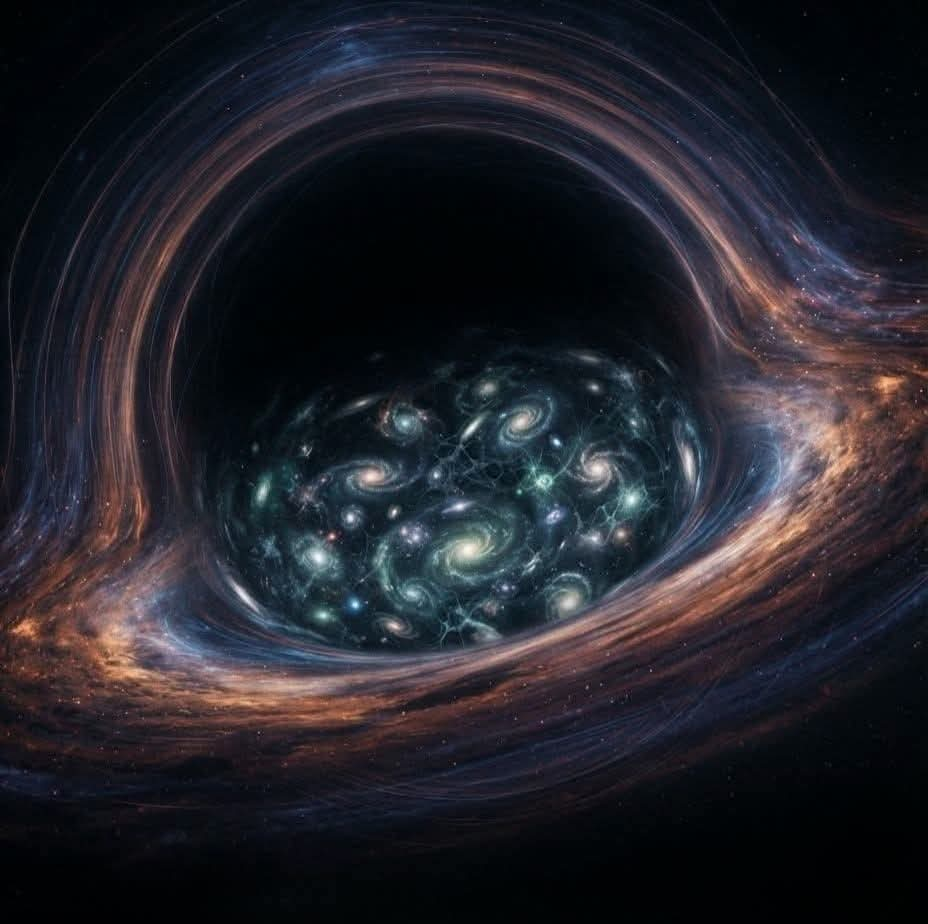
For decades, scientists believed our universe began 13.8 billion years ago with the Big Bang. This theory suggests everything expanded from an infinitely dense singularity. But what if that is not the entire story? A fascinating hypothesis suggests that we might actually be living inside a black hole that exists within a larger multiverse.
Unorthodox as it sounds, this idea is gaining new traction. Recent astronomical observations made by the James Webb Space Telescope (JWST) now provide unexpected hints supporting this model.
What Happened Before the Big Bang?
Standard cosmology struggles with the concept of a singularity. At a singularity, matter crushes into infinite density, and the known laws of physics completely break down.
To solve this issue, theoretical physicists proposed the Black Hole Cosmology model. This theory utilizes Einstein-Cartan-Sciama-Kibble torsion physics. It suggests that our entire observable universe formed within the interior of a massive parent black hole.
The Big Bounce vs the Big Bang
Instead of starting from absolute nothingness, matter fell into a massive black hole in a parent universe. Eventually, this infalling matter reached a critical density threshold.
At this extreme point, quantum effects of particle spin created a strong repulsive force. This force halted the gravitational collapse and caused a massive rebound, known as the Big Bounce.
Why the Universe Expands from Within
The Big Bounce released immense matter and energy. This rebound stretched the surrounding space-time fabric inside the black hole. We observe this expansion today as the expansion of our universe.
Essentially, space itself stretches as everything moves outward. Furthermore, the event horizon of that parent black hole forms the outer boundary of our universe. This boundary permanently traps everything within it.
Interestingly, plugging the average matter density of our universe into Schwarzschild’s black hole radius equation yields a direct mathematical correlation.
JWST Finds a Preferred Orientation in Space
Theoretical equations require observational evidence. This is where the James Webb Space Telescope plays a crucial role.
If our cosmos is isotropic, galaxy rotations should be entirely random. About 50% should rotate clockwise, and 50% should rotate counterclockwise. However, recent deep-field observations from NASA’s JWST Official Site show a striking anomaly. Nearly two-thirds of the observed distant galaxies rotate in the exact same direction.
This asymmetry implies a preferred axis in space. If we are living inside a black hole, its rotational energy would imprint angular momentum onto our space-time fabric. This rotation could directly align the spin of early galaxies.
Solving Cosmic Inflation and Early Galaxy Secrets
Black Hole Cosmology also addresses two major cosmic puzzles:
- Space Inflation: The Big Bang requires an artificial inflation period to explain rapid cosmic expansion. In contrast, the Big Bounce model naturally drives exponential expansion right after matter reaches critical density.
- Early Galaxy Formation: JWST discovered fully formed ancient galaxies earlier than expected. Leftover matter seeds from the Big Bounce likely accelerated this early galaxy growth.
Is Our Cosmos Nesting Inside a Multiverse?
Despite its elegance, scientists remain cautious. Confirming galaxy spin directions across billions of light-years requires complex data processing. Measuring whether our universe possesses an event horizon is also extremely difficult.
You can read more about space-time structures on ESA’s Space Science Portal. As advanced space observatories scan deeper into space, they continue to challenge modern astronomy. We might eventually confirm that we are living inside a black hole, continuously expanding within an endless multiverse.