Unlocking Nature’s Physics: How Tiny Spider Webs Hold Heavy Drops of Water
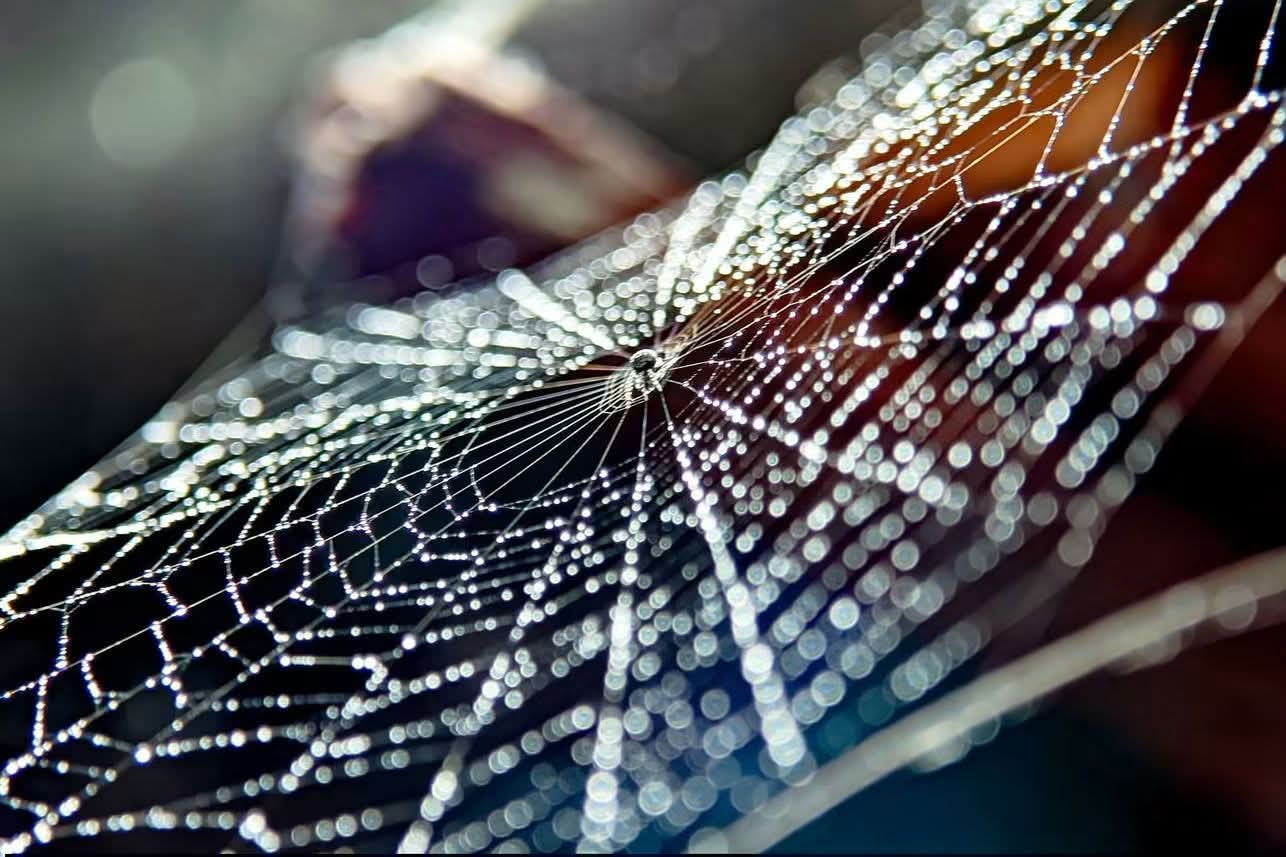
Have you ever walked through a garden on a morning and seen a spider web shining in the sunlight covered with tiny perfect droplets of dew? This is a natural scene but when you pause and think about the physics it feels very confusing.
How can a silk strand— one hundred times thinner than a human hair—hold water droplets that weigh much more than the silk itself without breaking or letting the water slide away?
Spiders are not only builders; spiders are also skilled material scientists. The secret of this phenomenon comes from a mix of shape, physics and biology. Let us explain how spider webs gather and hold water.
1. Surface Tension: Water’s Natural Sticky Force
To understand how dew sticks to silk we first look at how water behaves.
Water molecules are naturally pulled together by a property called cohesion. In a droplet molecules on the outside have no water molecules above them so they pull more tightly toward the inside. This makes a elastic skin around the droplet a force called surface tension.
Because of surface tension water droplets naturally form shapes to reduce their surface area. When a tiny drop of moisture lands on a silk strand surface tension keeps the droplet together of letting it run down the thread like a flat stream.
2. The Spindle-Knot Architecture
For a time scientists thought spider silk was smooth and even.. A 2010 study published in Nature showed that wet spider silk changes its structure in a fascinating way.
When spider silk comes into contact with moisture—like morning fog or dew—its tiny structure changes quickly:
Spindle-Knots: The silk makes swollen bumps along the thread called spindle-knots.
- Joints: Between the knots there are narrow stretches called joints.
This pattern of knots and smooth joints makes a design that is made just to gather and keep water.
3. The Laplace Pressure Difference (The Magic Engine)
Once water lands on spider webs how does it move into place. Stay there? The answer comes from dynamics, specifically the Young–Laplace equation.
In mechanics curvature makes pressure differences in liquids called Laplace pressure. Because the narrow joints of silk strand have a curvature than the round spindle-knots a pressure difference is created along the thread:
This pressure difference works like a natural pump. It pushes water droplets away from the smooth joints and pushes them to merge into bigger stable droplets on the spindle-knots.
4. Hydrophilic Viscous Coating
Physics is helped by chemistry. Spiders coat their capture silk with glue droplets made of glycoproteins and water‑attracting compounds.
This sticky water‑attracting coating pulls water vapor from the air. As gathers the glue mixes into a stretchy liquid around the silk core making a flexible cushion that holds the droplet on the fiber even when wind shakes the web.
- Why This Matters: From Spider Webs to Water Conservation
Knowing how spider webs gather water is not a science question—it is driving new ideas in biomimicry engineering inspired by nature.
Scientists are now copying the spindle‑knot shape of spider silk to make fibers that can gather drinking water directly from fog and atmospheric moisture.
These materials could soon give water to dry coastal communities and desert areas all, over the world.
The Bottom Line
The time you see dew hanging from a spider web you are not only looking at morning dew—you are watching fluid mechanics, surface physics and structural engineering in action. Nature made this system work millions of years ago and modern science is only just catching up!