The Mind-Blowing Science of Honeybees: 3 Superpowers You Didn’t Know They Had
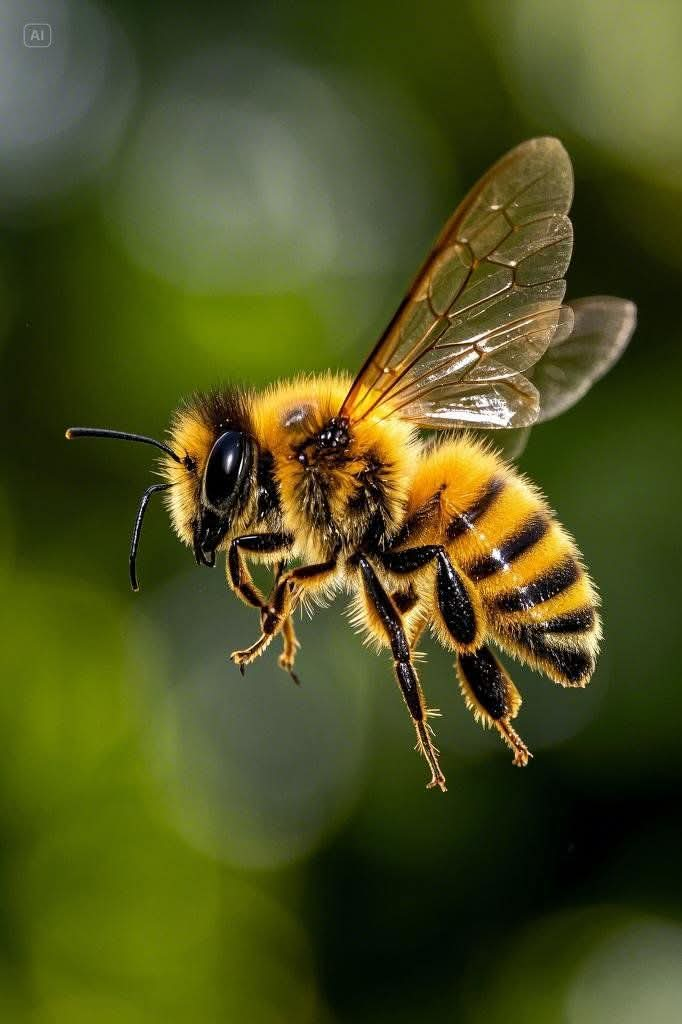
When you think of a honeybee, you probably think of a little, buzzing insect making honey and occasionally ruining a summer picnic. But behind that fuzzy yellow and black exterior lies one of the most sophisticated engineered organisms in the natural world.
From digestive systems that serve as digestive systems to navigating by ultraviolet rays, bees operate at a level of biological sophistication that rivals modern technology. Here are 3 amazing scientific facts about honeybees that are a testament to how incredible these little creatures really are.
1. Honeybees have two stomachs (and one is for storage)
Did you know that beetles don’t digest the nectar they gather for honey? You see, the honeybee has actually two different stomach chambers:
The Honey Stomach (Crop) This is a special organ functioning as a bio-reservoir. When a bee gathers nectar or water it stays in the honey stomach completely isolated from the digestive system. Here special enzymes such as invertase mix with the nectar to break down complicated sugars. When the bee returns to the hive it spits up this processed nectar to pass on to worker bees on their way back to make honey.
The Midgut (True Stomach) Between the honey stomach and the true stomach is a small internal valve called the proventriculus. When the bee needs energy to fly, this valve opens a little and lets just enough food into the midgut to be digested.
This evolutionary separation means that the food for the survival of the colony is never tainted by the bee’s own digestive process.
2. They See in Ultraviolet (. Can’t See the Color Red)
A honeybee sees the world in a way that’s far from how we see it. Humans see light from the end of the spectrum all the way to violet. Bees cannot see red. A bright red rose looks like gray or black to a bee.
To compensate bees can see light. This gives them a visual world that humans cannot see:
Natural Runways: Many flowers have ultraviolet patterns called Nectar Guides. To a human a petal may look plain yellow.. To a bee the flower shows a target‑shaped ultraviolet map that points straight to the center where nectar and pollen wait.
Efficiency in Foraging: This ultraviolet vision lets bees find high‑yield flowers, at once. They save a lot of energy when they travel to collect food.
3. The Waggle Dance: Natures Most Sophisticated Navigation System
Perhaps the fascinating part of honeybee life isn’t what they look like—it’s what they do. When a worker bee finds a source of nectar or pollen more than 100 meters from the hive she doesn’t just fly back and rest. Instead she. Performs a special movement called the Waggle Dance.
This dance was first figured out by Karl von Frisch, a scientist who studied animal behavior. He won a Nobel Prize for cracking this code. The waggle dance isn’t random—it turns information about location into body movements that other bees can understand.
Direction: The bee runs in a loop that looks like a figure-eight. As she moves in a line through the center she shakes her abdomen. The angle of that run—measured against the vertical part of the honeycomb—tells other bees the direction to the flowers. That angle matches the direction of the sun. So if the dance is straight up the food is in the direction of the sun. If its angled 45 degrees to the left the food is 45 degrees to the left of the sun.
Distance: The length of time she waggles during that line tells the bees how far away the food is. One second of waggling means one kilometer. So if the dance lasts five seconds the food is five kilometers away.
In a few minutes one bee can tell her sisters exactly where to go. This dance is more, than a trick—it’s a full communication system. It’s how bees share maps without words. It’s how they navigate the world and keep their colony fed. It’s nature’s advanced way of giving directions.
Final Thoughts
Honeybees are far more, than pollinators. Honeybees are master navigators. Honeybees are processors. Honeybees are specialists. The time you spot a bee buzzing near a flower remember that you are looking at a miniature marvel of nature operating with astonishing precision.