
Cut a Photon in Half: Scientists Discover Quantum Vacuum Reality
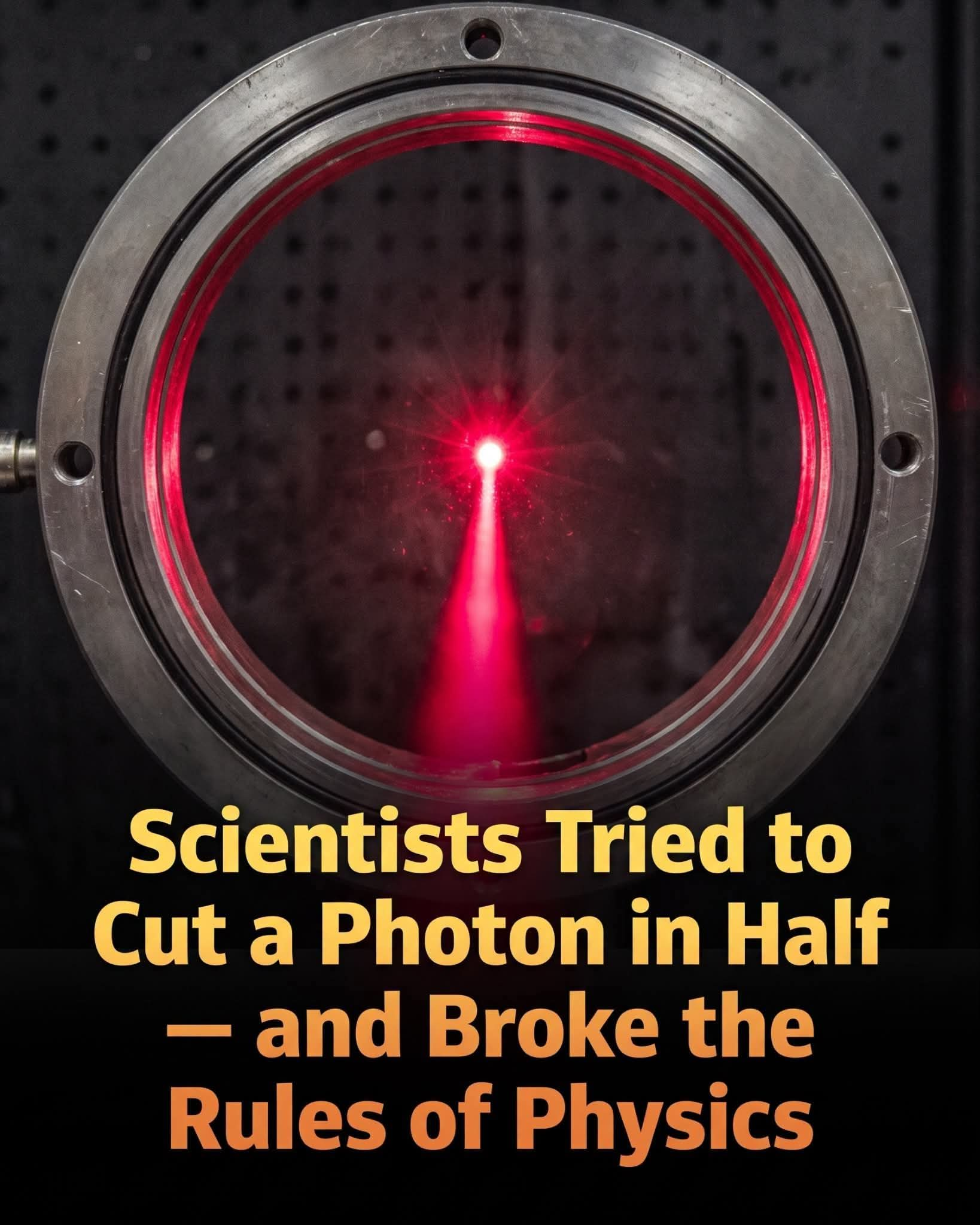
Standard physics classes teach us that a photon is a fundamental, indivisible packet of light. It represents the smallest unit of light energy. You can block, absorb, or redirect a photon. However, splitting one in two seemed impossible—until recently.
A team of researchers from the University of Oslo decided to test this boundary. They asked a simple question: What happens if an ultra-fast optical shutter cuts a moving photon?
The theoretical result surprised everyone. The experiment did not yield two simple photon pieces. Instead, it unlocked a quantum reality capable of producing an unpredictable stream of new photons that mathematically stretches toward infinity.
Here is how attempting to cut a photon revealed mind-bending properties of the quantum vacuum.
The Theoretical Experiment: Cutting Light Waves
To test what happens when you cut light, researchers designed a thought experiment. They used a single photon moving through space as a wave packet.
- The Target: A single photon travels toward a specialized mirror.
- The Cut: The mirror reflects the front half of the photon wave packet.
- The Twist: An optical shutter yanks the mirror away at ultra-high speeds before the back half arrives.
Intuition suggests you would end up with two truncated half-photons. However, quantum mechanics rarely follows classical rules.
Quantum Superposition and Unpredictable Photons
Instead of cleanly splitting into two pieces, the sudden truncation forces the system into a complex quantum superposition.
The abrupt change in boundary conditions alters the state of the particle. Consequently, the system enters a state with a probability of finding zero, one, two, or even infinite photons.
How does cutting one photon create new light out of thin air?
Tearing the Fabric of the Quantum Vacuum
The answer lies in Quantum Field Theory (QFT). Space is never truly empty in quantum physics. The vacuum is a active sea of underlying quantum fields fluctuating with energy.
When the shutter moves instantaneously, it creates a severe mathematical discontinuity in the quantum field. This sudden jolt across space and time excites the ground-state quantum vacuum.
By changing boundary conditions so fast, energy pumps directly into empty space. This force causes brand-new photons to pop into existence from the vacuum itself.
The Mathematical Catch:
If the shutter opens instantaneously (t = 0), the math dictates an infinite photon count. Real-world shutters take a fraction of a femtosecond to operate. Therefore, generated photons remain finite and measurable in practice.
Why This Breakthrough Matters for Modern Physics
Cutting light to create extra photons is an impressive concept, but the study offers deeper insights:
- Understanding Spatial Boundaries: It reshapes how physicists view localized particles interacting with physical barriers.
- Preserving Causality: The findings help ensure field interactions do not violate causality, maintaining that causes precede effects.
- Refining Particle Interactions: Researchers gain a clearer picture of particle behavior without breaking chronological physical laws.
Final Thoughts
This research by Rukan, Gulla, and Skaar reminds us that dividing light disrupts space itself. By attempting to cut a photon in half, scientists uncovered deeper layers of how light, space, and vacuum energy interact.
To learn more about the complete study, read the official paper on Physical Review Letters.