Why Does a Fan Feel Cool Even Without Cooling the Room?
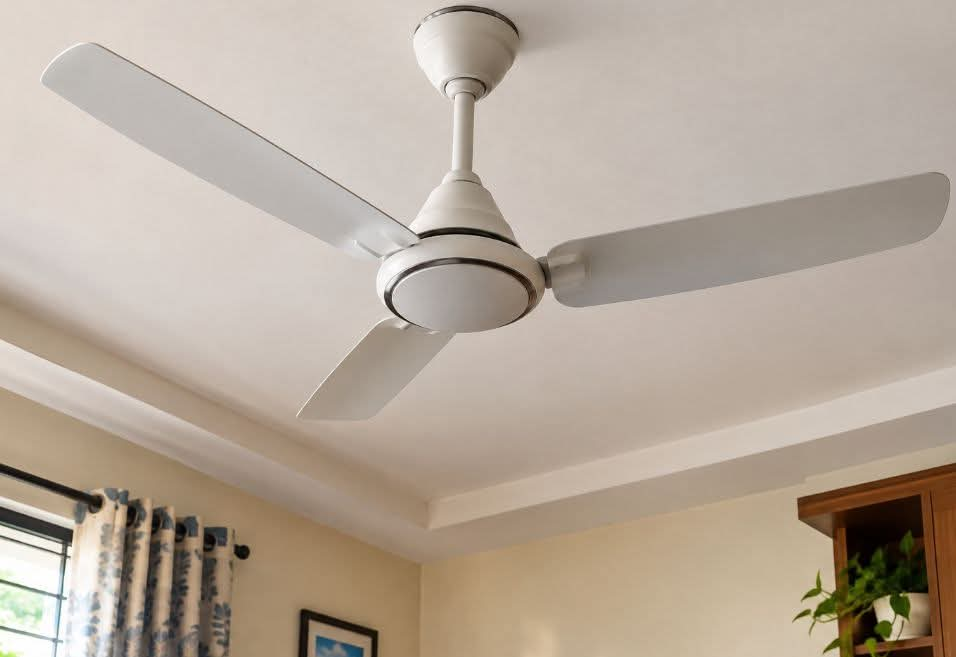
Have you ever flipped on your ceiling fan on a sweltering summer afternoon and felt a refreshing breeze wash over you? Like magic, it seems, the fan will whisk away the stifling air and cool you to a tenth of a degree
Here’s the twist that will forever change your perception of fans: they might make you feel cooler, but they actually do the opposite of what you’d expect by leaving your room slightly warmer!
So, how exactly does a fan manage to trick your mind into feeling cool? What’s the science behind these whirly things? And finally, how can you use your fans to maximum efficiency? Let’s dive right in!
The Science: Why Fans Make Us Feel Cool
Unlike air conditioners, fans accomplish their cooling magic by interacting with your own body heat! A fan uses two interesting physical processes to make you feel cooler: the latent heat cooling effect and convection.
1. Accelerated Evaporation (The Latent Heat Effect)
Your body is a masterpiece of physics, and it uses some neat tricks to keep you from being fried. Whenever you feel hot, your body begins exhaling sweat to cool itself. Here’s the thing about sweat: it’s mostly water, and water has some crazy physical properties.
The evaporation process requires more energy than you might expect: in order for a water molecule to escape from a liquid into a gas, it needs to consume thermal energy in order to overcome the liquid’s surface tension
Now, where will this lost thermal energy go? If you’re in a stagnant room, the warm air molecules surrounding your skin will absorb the energy from the evaporating sweat. Not only does this steal your body heat, but also the newly vaporized water molecules will carry it away in the form of latent heat
The trick that fans perform is that they rid the boundary layer of hot air surrounding your skin. By doing so, they allow your sweat to evaporate at an accelerated rate by introducing more dry molecules to meet the moist boundary layer
2. Enhanced Thermal Convection (The Wind Chill Effect)
Your body’s preferred method of heat transfer, convection, is another reason why fans can be useful. When you turn on a fan, it will begin blowing air at your skin, thereby increasing the rate of convective heat transfer from your skin to the air molecules. This has the effect of pushing your body heat away from your skin in an effort to cool you down
Convection is dependent on the insulating properties of a heated air layer. On a calm summer day, your body will create a warm boundary layer of air around itself, thereby impeding further heat loss by convection due to the greater temperature gradient between your body and the surrounding air. As mentioned previously, a fan will increase the rate of convection by blowing away some of this heated air layer, effectively reducing this insulation and allowing your body to lose more heat
Have you ever heard about the wind chill factor when it comes to cold weather? If so, then you already understand the basics of convection and how it relates to fans! The wind chill factor is basically a fancy term that means “the rate at which your body will lose heat in windy conditions”, and it accomplishes this by taking the convective heat loss and factoring it with the actual air temperature
3 Pro-tips to Make Fans Work For You
Now that you have some background knowledge on how a fan works, here are some tips that will help you use your fans in the most effective manner:
Turn them off when you’re not in the room since they provide no meaningful benefit while you’re away. You’re just wasting electricity to no one!
Use them in reverse during the winter. A ceiling fan’s direction can be reversed so that, rather than blowing air downward, it blows air upward, thus redistributing the warm air that has accumulated at the ceiling during the heating season
Use ice water to get the most out of a portable fan. Just place a shallow dish of ice water in front of a desk fan and let the magic happen. This is basically an impromptu swamp cooler!